
It's never too late to learn: A journey to redefine love and success after 50

 Apple Podcasts

 Spotify

 Castro

 RSS Feed

 YouTube
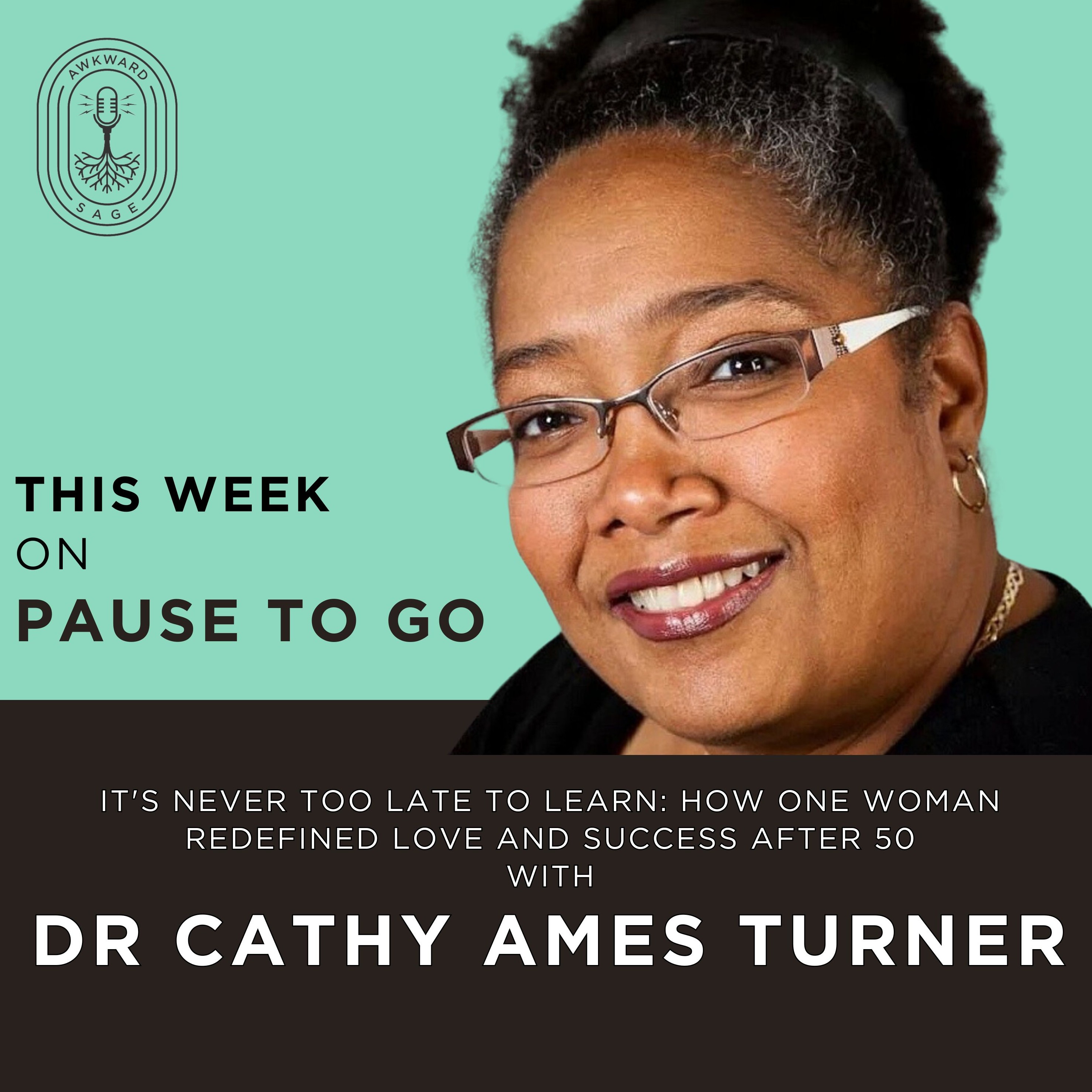
In this episode of Pause to Go, host Bree Luck engages in a heartfelt conversation with Dr. Cathy Ames Turner, a pastor, coach, scholar, and mother who achieved her doctorate in her sixties. Reflecting on her transformative journey from middle school to menopause, she speaks about her self-discovery, the evolution of her relationships, and her strides in education. The discussion shifts to meaningful experiences concerning issues like racial disparities in healthcare, the need for better menopause care, particularly for women of color, and the importance of de-stigmatizing conversations about puberty and menopause. The episode ends with Dr. Cathy expressing her faith, her belief in everyone having a life assignment, and her aspiration to help individuals impacted by mass incarceration through coaching.
0:00 PTG_CathyAmesTurner
00:00 Introduction to the Podcast and Host
01:10 Guest Introduction: Dr. Cathy Ames Turner
02:57 Dr. Cathy's Journey to Education and Self-Discovery
06:23 The Challenges and Triumphs of Menopause
24:47 Understanding Empathy and Self-Care
27:43 Journey of Personal Growth and Education
31:54 Overcoming Challenges and Embracing Change
40:25 The Power of Faith and Community
Meet Dr. Cathy Ames Turner
Dr. Cathy Ames Turner is a devoted wife, mother, and grandmother (Oma), as well as a pastor, scholar-activist, and life empowerment coach. Known a by various titles such as Pastor Cathy, Dr. Cat, Miss Cathy, and Honey (by her husband, Tony), Cathy's diverse roles converge in coaching individuals, families, and professional teams through life's challenges and transitions.
With a specific focus on issues related to carceral systems, foster care, and life-altering experiences, Cathy is committed to guiding individuals and families through successful reintegration or personal discovery.
As a pastor in Central Virginia and clergy at the local regional jail, Cathy has witnessed the profound impacts of incarceration on families and children in the foster care system. This firsthand experience led her to earn a doctorate from Fielding Graduate University in 2023, focusing on the experiences of formerly incarcerated African American men during reintegration. Her research underscored the crucial role of relational reintegration and the support from faith communities, families, and reentry professionals for successful outcomes.
In her coaching practice, Cathy provides a nurturing space for clients to cultivate self-awareness, engage in reflection, and take purposeful action. Drawing on psychology, human development, spiritual truths, and group dynamics, she facilitates progress with empathy and expertise.
Cathy extends her transformative expertise to teams, fostering an environment where members grow together with open communication, trust, and a shared commitment to client success. In essence, Cathy Ames Turner embodies a multifaceted professional deeply committed to facilitating positive change in the lives of individuals, families, and teams.
Connect with Bree
Instagram: http://instagram.com/awkwardsagemedia
LinkedIn: https://www.linkedin.com/in/breeluck/
Join the FB Group: https://www.facebook.com/groups/pausetogopodcast
Connect with Dr. Cathy Ames Turner
https://www.communityhealingcoalition.org/
https://www.ricministries.org/
Production credit: Awkward Sage Media, LLC
Did you love this episode?
Check out other shows on the Awkward Sage Network!
Want to Support the Pause to Go Podcast?
Here are four ways:
1. Leave a written review on Apple Podcasts or drop 5 stars on Spotify
2. Send me a voice memo, letting me know your thoughts about the show
3. Buy me a coffee. A little caffeine goes a long way to ignite midlife convos.
4. Follow @awkwardsagemedia on IG and FB!
00:00 - Introduction to the Podcast and Host
01:10 - Guest Introduction: Dr. Cathy Ames Turner
02:57 - Dr. Cathy’s Journey to Education and Self-Discovery
06:23 - The Challenges and Triumphs of Menopause
24:47 - Understanding Empathy and Self-Care
27:43 - Journey of Personal Growth and Education
31:54 - Overcoming Challenges and Embracing Change
40:25 - The Power of Faith and Community
0:00 The things I learned, it changed me. No, no, it didn't change me. It brought me out of myself. It freed me in a way that I'm comfortable in my own skin. And I, you know, I didn't know that I wasn't. I didn't know that I was afraid of my own shadow for a long time. Welcome to pause to go, the podcast that's all about making the most of life's transitions from middle school through menopause. I'm your host, Brie Luck, joining you as we embark on a journey of self discovery and questionable decisions. Get ready for heartfelt conversations, expert insights, and personal stories that'll have you laughing, crying, and saying, thank goodness I'm not alone. If you've lost your midlife cris survival. Kit, we've got you covered. So join me, won't you? And together we can pause to go.
1:10 Welcome to another episode of pause to go. I am your host, Bree luck, and today we are honored to have with us Dr. Kathy Ames Turner. You are going to love Dr. Kathy. She is a pastor, a coach, a mama, an Oma, and a scholar who earned her doctorate in her 60s. We talk about everything about life from puberty through menopause in this episode. And I'm so grateful for this chat for many reasons, but especially because BIPOC Americans, we know, have more disruptive, perimenopausal, and menopausal symptoms and get less support from their medical providers than white women who are going through the change. In short, black women are hurting more and getting helped less. And we need to change that as a culture.
2:05 And one way to make that change is to talk about it. And that's exactly what we do in this episode. But we talk about more than hot flashes. We also talk about larger life issues, like what it was like for Dr. Kathy to get her undergraduate degree in her fifty s and her PhD in her sixty s. And then we're getting into the nitty gritty of love and marriage with Kathy's transition from unhealthy past relationships to a loving, communicative partnership with her husband, Tony, and how it influenced her growth as a person and a professional. So let's delve into a conversation about life, assignments, childhood dreams, and the power of stepping into your fullest self at any age. Kathy, I love that I get to call you Dr. Cat now. Can I just call you, even though I've called you Kathy for years? Can I call you Dr. Cat? Sure.
3:07 Does it feel? Does it does. I'm still getting used to it. How long ago. Did you finish your graduate program? I turned in the final, final dissertation April of last year. I actually had the opportunity to go across the stage January of last year. It was amazing. Fielding is graduate university for older adults, and it's a hybrid program. And so most of my interactions with people that I met was mostly online.
3:48 Once or twice a year, we'd see each other, but I actually met people at graduation that I had been online with for, like, six years. And we've cried together. We've edited each other's work and finally got to hug each other, which was major. It was major. One woman in particular. We've grown to be very close, and we had not ever met in person, but we felt like we knew each other. And then seeing each other was crazy, even with masks on, because we were masked up last January. Yeah, it was amazing. But, yeah, still getting used to people calling me doctor, whatever.
4:39 Yeah. It's such a huge accomplishment at any age, but it's especially a huge accomplishment, I think, in midlife. I agree. To invest in yourself, to invest in your community in that way, to invest in your work in that way at that time is just admirable. And our brains are shifting also. So to put your brain through all of that is so good for you to do. And also a real challenge, I would imagine. Yeah. You know, it's interesting because I never really thought about the how or the what of it.
5:26 Every time I tried to say, no, I'm not going to do this, I kept feeling in my heart, you need to do this. You need to do this. I started in January 2015, hadn't thought about anything having to do with hot flashes or sleeping. And I always joke with God. I said, look, if you had told me what this was going to require, it never would have happened. And I know that's why you didn't tell me, because. And it's interesting framing it the way you're framing it, right? Thinking about the time of life, I hadn't given it a thought, and thinking about it now, it's like, wow, that's pretty crazy. You say crazy, I say courageous. Okay. I like courageous. I like courageous. Yeah.
6:23 So let's go back a little bit. How old are you and where are you in your menopause journey? Yeah, I am 63. I'll be 64 in March next month. As far as my journey, that's an interesting question. I remember hot flashes starting when I was 52. So eleven years ago, my grandmother passed a little bit ago, and she was, like, my best friend. She was 97. 97. And yes. And she was still having night sweats because I remember like grandma, does this end?
7:04 She's like, I don't think so, baby. And my mom is still experiencing night sweats and things like that and hot flashes. And my mother turned 83 last fall. So, yeah. I don't know how to tell you where I am. I mean, I think about where my mom and my grandmother were in their journeys. I probably say I'm just getting started. Yeah. Wow. I was also very close to my grandmother. She passed away almost a year ago. And she, so I, yes. Something about those grand, I'm telling you. Yes. My goal is to be a grandmother like she was and maybe still is to me.
8:00 Right. She passed on, but she's still there in me. Yes, but she said that she didn't even go through menopause until she had a hysterectomy when she was in her mid 90s. That's what she said. Of course she did. Of course she did. Her period stopped at some point. So the definition of menopause is actually the typical definition of menopause is that you've gone for twelve months, one year without menstruating. Okay. So the time leading up to that, when you have kind of an irregular period and mood swings or hot flashes for a lot of people, for many people, they experience them more in the time leading up to menopause, in the first year of menopause, but not everyone, clearly, but she was put on hormones in her 40s. She was put on hormones for a number of different reasons. She was experiencing a number of different symptoms. So that really controlled her hormonal fluctuations and experience in a different way. And it's interesting because women of color are not diagnosed
9:32 with hormonal imbalances in the same way that white women are in the United States and don't get the same kind of hormonal treatment. They're often told, tough up. You've got this, you can bear this. Anyway, when I hear about your mother and your grandmother having hot flashes for their entire postmenopausal lives, it really makes me think about that difference in medical treatment. Right. It's a problem teaching me something right now, honestly, because I didn't know. I actually had a conversation with a friend earlier this week who just did some hormonal, had a hormonal treatment. We didn't get into why.
10:30 And she's a white woman, lives out on the west coast. And I had no idea that you're. Teaching me well, and that's why we're here. Right. We're here, not for me to teach you so much, because you're also teaching me, but to share. These are stories that women didn't talk. People with ovaries. I'm not just going to say women, because, of course, many people who go through menopause don't identify as women. And I would say an increasing number of people don't identify as women. I do. And I believe you do. I do. But we don't talk about it. And so how can we get consistent, quality care in our lives if we're not educated? So I just want to thank you for coming on to talk about your experience, because I think it's going to be really helpful for a lot of people. Now I know where you are in your journey.
11:36 Can we go back, though? Because I really think for a lot of us, this started with puberty. Did you talk about puberty? What was it like for you when your period started? Do you remember that experience? You're shaking your head. I remember starting, and I would say I started early. Do you remember how old you were? I want to say I was ten. And I didn't. Wasn't a lot of education. It was just something you kind of dealt with. I remember having very, even young, very long cycles, menstrual cycles during the bleeding part, at least like five to seven days and sometimes longer. And compared to people who would tell me, oh, three days, and I'm like, what is that? And it seems like the older I got, the heavier they got and sometimes longer. Lasted longer. I became well acquainted with those overnight, huge overnight pads and I remember wearing tampex and those huge pads and still wasn't necessarily enough. And again, never talked about this with anyone. So
13:08 this is a first. Thank you. Thank you for being willing to. Yeah, of course, cramps were ridiculous. And I had a cousin, I remember she would be in bed for two or three days with cramps. I wasn't that bad, thankfully. But again, who talked about. No one talked about it. So, yeah, puberty was interesting because I didn't really know all that was happening with my body. I knew literally what was happening. But as far as the changes that would take me into womanhood, that would take me into adulting and all that stuff, I didn't know any of that.
13:55 Yeah. It sounds like that happened. That was reflected as you approached menopause, too. That that was similar, right? Absolutely. There's sort of that feeling of, on one hand, there's sort of. I find myself sometimes this sounds horrible, so I'm just going to put myself out there with this horrible thing that I'm about to say. Sometimes I see people on TikTok or reels or something, and they're talking about parenting. And I have that gut response, which I think is some kind of old response, like, it's not me. Right? It's a reaction to something. It's a cultural reaction. But I'll see a parent, and I will be like, do you feel like you're the first person who had a baby? That's the thought in my head. Right. My first thought is not always compassionate. My first thought is, get over it, okay? And then I come around to that compassionate place, and I think with puberty and menopause, it's kind of similar. Right. There was a long time sort of cultural attitude of, you just got to deal with it. That's your lot.
15:15 And now the hope is that there's a movement towards, like, oh, I can actually get more support that I need in this time so that I can be my fullest self and do all the things that I need to do to live the life and to accomplish the things that I want to accomplish. So that was me showing that sometimes we have a less compassionate side for these natural life changes. I don't know if I would call it less compassionate as much as for me, it's like, things have changed so much, and now people are, like, in your face with everything, right? And as you were talking, you know that commercial where the woman is on the bus and she gets up and I think the tagline is, gushes happen. And I remember turning to my husband, I said, we're talking about these things now. It was on television. Right? So it's like commercials. Thank you. Thank you. For five year olds and three year olds. Just.
16:34 I think it's more that people are just more transparent with it now because they're allowed to be. And if we had said any of these kinds of things when. I know when I was growing up, it would have been. I'd have gotten a look, like, straighten it up. We don't talk about those things. What? Depending on the company I was in, I might have gotten smacked. Yeah. I wouldn't label it not being compassionate. It's a switch, and it's something for us to. It's like, whoa, what? You're saying these things in public now, and it's okay. I think that's what comes to me. Well, thank you. Yeah.
17:26 We got to be kind to ourselves. We're learning and growing still. We are learning and growing. And you talking about that commercial, I know, that feeling. And then I also see in my own family. So I have two daughters and my husband, my poor husband, because I was very private about things. I mean, he's never seen me go to the bathroom or anything like that. You know what I mean? We're very traditional, I guess, in that way. But I have two daughters, and I've tried to normalize all bodily transitions as much as I can.
18:08 And, man, does it get talked about in my household. So now my husband is very well versed in everything to do with periods, menopause, perimenopause, sex, all sorts of things. And it's fascinating. And my hope is that my kids don't have nearly the shame that also comes about from not talking about things, that they don't have shame if they leak. Right. Or they don't have shame as they start to age, because there's so much ageism, too. Yes.
18:49 That's a whole other aspect that we reach as we get to this phase in life. Yes. So, anyway, my hope is that by talking about it, that we open up our hearts to the full human experience, not necessarily that we gross people out. Understood. Yeah. So looking at that then and looking at your time now, now you're looking at it with a slightly different lens. Right? We're talking about it, yeah. Have there been any surprises in midlife for you? Anything that you didn't expect?
19:38 Well, okay. I'm about to get real personal. Okay. Yeah. My husband. I am on my third marriage. My first two marriages were just really mentally, emotionally, and physically dangerous situations. So when I met Tony, my husband, I tell people this is really the first time I've ever been married in my life, because it's a marriage, it's a partnership, it's a friendship, and I'm surprised at.
20:20 It's like I felt like I was living for the first time in my true self, if that makes sense. I didn't have to walk on eggshells. I didn't have to be afraid because of. I didn't do this right, or I didn't say that right. One thing that there's so much coming at me right now. My husband still tells me that I still sometimes live and think like a single mother. He goes to open the door for me, and I've already got my hand on it, those kinds of things. He's very traditional, and I love it. I absolutely love it. And I love being treated like a princess. And that was a surprise, to be able to experience that type of life. This is our 12th year together, and it gets better and better every day because he's my friend and we trust each other. We can talk about anything.
21:24 And I've never had that experience in my life. I've had, I can say, maybe three really close girlfriends in my life, and they know my life, period. But a man, to be able to share everything, the good, the bad, the ugly, and to be able to build a life that is not something that I ever thought I'd experience, really. I spent most of my life in survival mode. I had a talk with my youngest about this about two summers ago. And now both my children, we've had this conversation, and they let me know, mom, you've raised us in survival mode, and I'm so grateful to be able to have those conversations with them because they're right. What would it have been like if I wasn't in survival mode? What would it have been like if I had peace of mind and was able to just enjoy them and have them enjoy me? But we were definitely in survival mode, and I'm not like that anymore, and I'm learning how not to be that way anymore. I have conversations with my young adult.
22:39 They're not even young adults. My son, who is 37 this year, and my youngest will be 29. And how did that happen exactly? But the joy of being able to talk to them, still give advice when it's solicited. But to be able to listen, to be able to really hear them, that's a surprise, too, I would say. The shift in the relationship. There'll still times when they'll give me permission to be mom because that's who they need, you know, go.
23:22 But for the most part, it's a joy to be able to listen to them and to be heard, to be able to, like, with my youngest, we have these conversations all the time where we're both like, man, seriously. And I'll be able to admit I messed that up royally. To be able to have those kinds of conversations is freeing. It's freeing. And to have those same kinds of conversations with my husband, to be able to be real, to be honest with people that I love, I would say in my life experience, that's been rare. One of the hats that I wear is the hat of a pastor.
24:11 And people have expectations of how pastors are supposed to act, how they're supposed to live and present themselves. And I've found that people almost resent you when you are too real with them. So being able to have real conversations with my children and my husband and those handful of female friends who know me. They just know me inside out, and I know them. Outside of that. I find that I kind of play the role depending on the circumstance, but I try not to do that as much as possible. It just depends on what people are able to take. And that sounds kind of crazy, but it's not really, is it? Because I think we all do that from time to time.
25:08 I think that if we are sensitive to the people around us, that we naturally, and maybe especially as women who want to offer guidance, compassion, a soft place to land, nurturing direction to people in life, we're looking to see where they are. I think that's a sign of being sensitive to the people you're with, being empathetic to how they are coming into the space so that you can meet them where they are.
25:55 The trick is, and it really sounds like you are finding it, which gives me hope, gives me hope for myself. The trick is, how can you see that? Honor the person and not lose yourself in the process? Not just give so much of yourself away or cover yourself up so much, or hide different components of you. How can you be your full self and present yourself in a way so that the person can receive what they need to receive? I don't know the answer to that.
26:37 Do you? I don't. But the fact that you're able to articulate that in that way, that's gold right there, what you just said. And I think that's an important component of, I was going to say, being true to ourselves and growing up, but also self care. That big buzword that we're all hearing now. Yeah. Being sensitive to others and at the same time being who we are and not having to apologize or hide behind a mask, or forfeit who we are for the benefit of that other individual. I love that word. We don't want to forfeit who we are for the benefit of someone beautiful. So as you made those major relationship shifts, it sounds like beginning with meeting Tony and not just meeting Tony, but cultivating a relationship and then cultivating a marriage with him. And then as that grew, that, then your relationship with your children started to shift, too, as you were getting out
28:11 of survival mode. Right. What do you think the catalyst was, or the mindset shift? What happened that had you come together with Tony and be able to receive? I'd say two things. One is being able to breathe. Being with Tony, I was able to breathe for the first time in a long time, I knew I was safe, which gave me freedom to explore other things, because I knew I didn't have to cover all the bases by myself. So that's the one thing. The second thing that comes to mind is going back to school. How old were you when you went back to school? I just say that because 50. It's really inspirational for people to hear 55.
29:04 Look, let me back this up a little bit. I started undergraduate school right after I graduated from high school in 1978, okay. And ended up. It didn't go well the first semester. I was just like, this isn't working. I don't know what I'm doing. I didn't have family support because I was the first one. First gen, that whole piece right there. Although I had cousins who had gone and done very well. So I tried again the next fall. Ended up coming back to Charlottesville because I was born in Charlotesville and raised in Maryland. Came back here to UVA, did my first two years at UVA. And once upon a time, in those days, if you weren't pre calm or some pre something, right? If you stayed in the college, there was this big joke, know, you staying in the college, you weren't smart enough or you weren't this, that, or the other.
30:13 So I tried to get into school, and I was not accepted. And instead of recognizing that the college was a perfectly legitimate option, I left. I left UVA, transferred to University of Maryland, hated it. Because even in the days when I was at UVA, even though there was a lot of racial tension, a lot of crazy stuff still happening because of 79 at that point, and I was three classes away from the women just being admitted. Had no idea about any of that until 20 years ago at UVA, first day of class, professor gave you name, number, and address, right? Very personable class ratio, 15 to one, maybe 17 to one. But small, intimate. You got to know your professors and you didn't call them. Dr. Whoever you called them, john, you called them by their first name. And so going to Maryland, the ratio was like 250 to one. And you were known by your social number, right. Nobody knew your name. The culture. It was a culture shock. Getting to UVA was a culture
31:46 shock. Going to Maryland was yet even another culture shock. So, long story short, I dropped out, right? First child born when I was 26, 2nd child born when I was 35. I didn't finish my undergraduate degree until I was 52. Good for you for doing it. I was determined. I was like, I started this, and I was all along taking classes online and taking classes, and finally I was like, I got to finish this. So I finished. And then at 55, I went back to get my master's. It was a master's PhD program. Can you tell us what your master's PhD program was in? Sure. I earned a master's in human development, and my doctorate is in organizational development and change.
32:43 And my dissertation leans more towards human development. I posed the question, what are the experiences of formerly incarcerated african american men as they reintegrate with their family and community and that education? Just going back to school, Brie, when I tell you I learned more about myself in those classes, when I learned more about my history as a black woman, when I learned more about our country, I got mad. I got angry.
33:32 And then there are things I learned about communication and human development and how brains change over time and family systems and all of these things. And I think that in and of itself really began to change. How I saw my family, how I saw the people around me, how I began to live in that space, but with a different understanding of why sometimes things go the way they go and why we respond and how we respond. The books. I love books. I've always loved books. My father, my biological father, I had two fathers.
34:19 I was loved by both, and I loved them both. I recognize fully that there are some people that don't have one that they can say loved them, but I had two, and I'm grateful for that, and I honor them both with my life. My biological father loved books. He used to tell me, he said, if you want to hide something from black people, put them in a book. He said that's what he learned. So he opened a bookstore in Maryland, in Baltimore, called North Star Books. And it was an Afro centric bookstore. And my father's passed on, of course. He wanted me and my siblings to carry on the legacy of North Star books. And we kind of let it fall because we didn't really understand then, but I understand now. And I'm in the process of another project where we're resurrecting North Star books, but that's another story altogether.
35:24 But my father instilled in me the love of books. I love books. And going through that master's phd program and reading the books that I had to read for that. And then when it got to the point where I was actually reading what I wanted to read for my research and all of that, the things I learned, it changed me. No, it didn't change me. It brought me out of myself. It freed me in a way that I'm comfortable in my own skin. And I didn't know that I wasn't. I didn't know that I was afraid of my own shadow for a long time. But I had to put on that strong veneer because you're not going to mess with my kids. You're not going to mess with me. And behind me, I'm like, oh, God, I hope they don't turn around and say anything, but you put on what you have to put on and the survival, right? I'm going to be what I need to be to make sure me and my kids are okay. And if I have to look like a bully, even though inside I'm melting and crying and screaming, that's what I'll look like. Well, I have to say, I've known you now for 18 years, maybe, I think maybe
36:54 a long time. We've known each other a long time. It's been a minute. I've never experienced you as a bully. Never. That would never be a word that I would use and never would even cross my mind in my experience of you. But I understand. But I understand. Yeah, I understand. Doing what you need to do to take care of your kids and to survive. Yeah. And in reality, it was usually more of a look or sharp tone to somebody who thought they were going to take advantage of one of my children. I was like, what? Look, if they hadn't shrunk down after what, I don't know what I would have said. But you say that, what? Just right. They'll be like.
37:47 I might have to practice that. Might have to practice that. What? But what you say, your story of going back to school, of getting mad, of educating yourself, of reading, of learning more about yourself in that time, honestly, I think that's the key. I know this sounds strange. I've been thinking a lot about success. About what success. Not so much what it means, but what it feels like. Right? What does success feel like? And when you tell me what you have done, how you've evolved, how you continue to evolve, how you continue to open up in your relationships, to your partner, to your children, to yourself, to your community, Kathy, that is success. To me, that is so rich and beautiful and inspirational.
39:02 And I think that you found the key to that in continuing your education, in leaning into curiosity and in being willing to reconsider how you live life and work with people and relate to people every day. Even as you're saying that, it just makes me like, oh, I want to meet that person. I get that, too. Let me tell you. You can ask my husband. Two days ago, I was like, prone on the floor, sobbing in my office, saying, like, what have I done? With my life.
39:58 So I get that feeling, and yet I know that I am trying to do what you're doing. I'm trying to keep being curious about mistakes, to be willing to have humility when I look back on my life, and to have curiosity as I am in the now. Right. It's hard. It is not an easy journey. If I can ask you. I know that you are a deeply spiritual person. Has your spirituality played into that? Has it evolved in that time as well?
40:40 It has kept me focused. If I didn't have my faith, if I didn't have my prayer life, I couldn't have finished school. There were days when all I wanted to do was crawl under the bed and give up because it was pulling so hard deadlines and writing and rewriting and rewriting and rewriting. I've written this seven times. I don't hear this. I don't see that. It's like I'm done, only to have to say, okay the following morning, I'm not done. Okay, I can do this. And then tucking in some more and, lord, help sister out. Please help me, because I don't know what I'm doing.
41:39 You know? It's like, I feel like, in many ways, the ivory tower of education is another place where if you don't know who you are and if you don't have a support system, you cannot last. It's not intended. And it's interesting because I said, coming through those last six to nine months, I was like, this is like hazing. And people would look at me like, if they weren't going through it right, they would look at me like, what are you talking about? I'm like, higher education, PhD programs, hazing. All right, academic hazing. Make me feel like a fool, make me roll on the ground and hate myself.
42:33 But it's okay. Without my faith, I couldn't have gotten through it. Without my husband praying for me, without a community around me praying for me, I couldn't have done it. So, yeah, my faith is everything. Yeah, we know that faith, that spirituality, that having faith in something larger than our very small human organism selves can really help us through our very small organism lives. And that also speaks to the work that you do as a Pastor, too. You are helping people find, grapple with, manage their faith.
43:26 I'm guessing that's what you do. That's a large part. I help people learn who they are, who they were birthed to be. I believe that every individual was put in the earth with a specific set of gifts and talents and an assignment. And when we can all come together and put those assignments together and move and work and love and keep it going, things get better. Beautiful. If you had one piece of advice or one wish, I'm going to give you the choice, like one or the other. For people in midlife, for people who are going through menopause, who are going through all of these shifts, a lot of people feel bereft. A lot of people feel like it's the end of a time. They feel hopeless.
44:21 They feel uncomfortable. What is one piece of advice or one wish that you would have for those people or for that person? I would ask them a question. I would ask them, when you were growing up, what did you want to be and are you there yet? Hoping that that would open up a conversation so that we can talk about where are you and what do you need to do to get to that next place, to reach that dream, to reach that goal, because it's in us and it's not time to give up. It's time to just kind of burrow in and keep moving. So what's the dream and have you reached it?
45:17 What did you want to be when you were a child? I haven't thought about that question for a very long time. For myself, honestly. There was a season where I wanted to be a teacher, and I am one, nontraditional as I am, but I am a teacher. I wanted to be a doctor. I had no idea what a PhD was. I wanted to be a pediatrician and I wanted to be a musician. And that's a part of my life that I don't spend enough time with. But I am a singer, a dancer, an actress, a musician. So I guess all of those things are now kind of meeting together and now I just get to enjoy moving forward with that. Then my wish for you is that you have more music and dance and creative impulse and community in your life this year.
46:25 Amen. I love that. I love that. Yes. Wow. Kathy, we are at the end of our time. I could talk to you for forever. But can you tell us again? I know we'll go sing together. You don't want to hear. Yes, you do. I'm not going to say that. I'm always being really hard on myself. People say, do you sing? And I say, oh, if I sing, run. But you know what? I'm not going to say that anymore. I'm not going to say that anymore. If I sing, don't say celebrate, because it means that I feel safe with you. All right. I'm going to hold you to it. How can we find you? How can we support the work that you're doing? Because you're doing some good work.
47:09 Thank you. Well, my husband and I have started a nonprofit called Community Healing Coalition, and our web address for that is chcvirginia.org. And I don't know if anyone might be interested in the ministry website, but if you are, that's ricministries.org. Great. I'll put both of those in the show notes as also doing. Oh, my gosh. And you're also doing coaching now, too? Yes, I am. And it's interesting that I've recently been thinking about, I have a coaching business called Epistan coaching, and I've actually been thinking about changing the name because I want people to hear the name and know what it is. So I'm thinking along the lines of maybe kinship connections or something where when people hear it, they know what we're doing. And my coaching is helping individuals impacted by mass incarceration and related foster care issues, helping them to move from that place of where they are to where they know they are in their hearts. So coming out, moving through a transition, and getting flat on their feet and moving forward.
48:32 Great. Well, I will share the other two websites. Thank you. And then as you continue to evolve, keep me posted. You and I need to do lunch. Well, thank you so much for your time today. I value you and appreciate you as a community leader and as a friend. So thank you. Thank you, Brie, I miss you. I'm so glad for this opportunity and look forward to seeing you soon. Me too. This is an awesome work that you're doing. Thank you. Absolutely. Thank you for being part of it. Here are my key takeaways from this conversation with Dr. Kathy Ames Turner. Number one, embrace your journey. Kathy's story of completing her doctorate in her 60s shows that it's never too late to follow your aspirations, whether it's continuing education or pursuing a new career. The key is to reflect on your childhood dreams and take actionable steps towards achieving them. Number two, normalize conversations about bodily transitions.
49:42 Let's actively work towards discussing topics like menopause, puberty, and hormonal imbalances. This can include having open conversation with family and friends, creating educational content, or advocating for better health care for women, particularly women of color. You can start by sharing this episode with a friend, a family member, or even your medical care provider. Number three, invest in self care and relationships. Dr. Kathy's shift from survival mode to focusing on relationships highlights the importance of self care and surrounding yourself with supportive individuals. Take time to assess your relationships and personal well being, engage in activities that bring you joy and stimulate your curiosity and communicate openly with loved ones to foster a balanced and fulfilling life.
50:40 Thank you for listening to the pause to go podcast. Special thanks to code based co working and WTJU radio for their support. This has been an awkward, sage production.

Pastor/Scholar/Coach/Playwright/Mom/Oma
Hello friends! I am Cathy Ames Turner. I am a wife, a mom and an Oma (grandmother), a pastor, a scholar-activist, and a life empowerment coach. Some call me Pastor Cathy, others call me Dr. Cat or Miss Cathy, and my husband, Tony, calIs me Honey. I coach people through life's challenges and transitions, especially -- but not exclusively -- individuals, families and professional teams through issues related to the carceral systems, foster care, or other life-altering and trauma-inducing experiences. I walk with individuals and families through successful reintegration (becoming an active participant in their homes and in society) or simply, on their journey from knowing who they are deep inside to becoming that individual in their daily lives.
As a pastor in Central Virginia and clergy at the local regional jail, I have watched families suffer through the impacts of having a loved one locked up and children put in the foster care system. I have also been personally impacted as well.
From the loss of income and missing family and friends, to the loss of emotional and practical support, and experiencing feelings of anger and shame -- it is heartbreaking. And what about the children? The children really suffer -- growing up without one and sometimes both parents. It starts a cycle of trauma that influences every area of their lives. And the incarcerated loved one? Their lives are changed forever as well.
Witnessing this cycle repeatedly inspired me to go back to school and in the spring of 2023, I earned my doctorate degree from Fielding Graduate Un… Read More
